
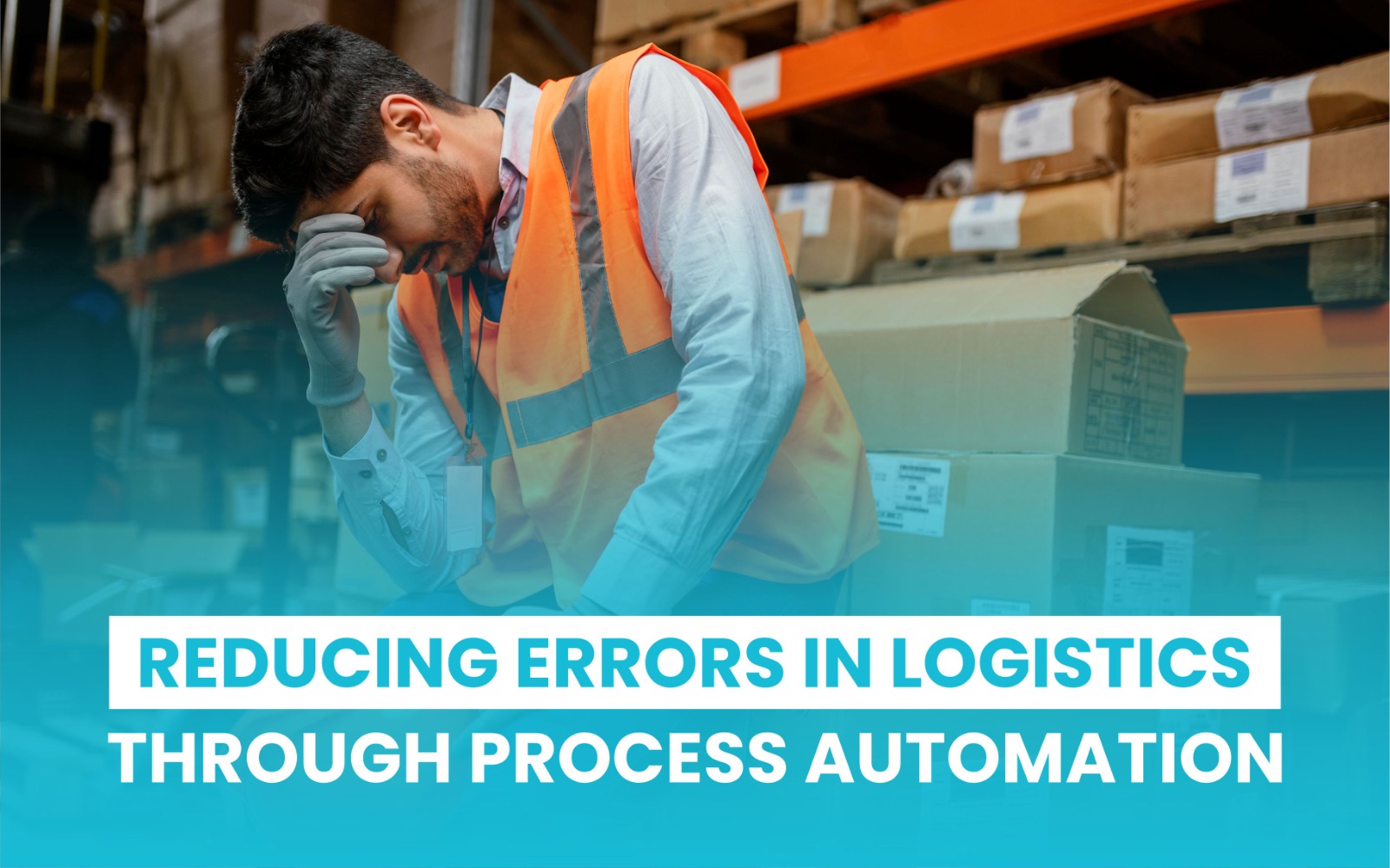
In logistics, precision isn’t optional. It’s fundamental.
Every movement, every scan, every entry carries weight. A single error – whether in inventory, documentation, or dispatch – can trigger a chain reaction across the supply chain. Delays compound, costs escalate, and customer trust takes a hit.
As supply chains become more complex and volumes continue to grow, relying on manual processes is no longer sustainable. This is where logistics automation steps in, not just as an operational upgrade, but as a strategic shift.
Because reducing errors in logistics isn’t about working harder. It’s about building smarter systems.
The Hidden Cost of Errors in Modern Supply Chains
Errors in logistics are rarely isolated incidents. They tend to multiply.
A wrong SKU entry can lead to incorrect picking. A missed scan can disrupt inventory visibility. A delay in documentation can hold up entire shipments. What begins as a small oversight often results in larger inefficiencies across warehousing, transportation, and delivery.
According to industry insights, manual supply chain processes significantly increase the risk of data inaccuracies and operational delays, especially as scale increases. This is one of the key reasons why businesses are rapidly investing in automated logistics systems to reduce dependency on human intervention.
The goal is not to eliminate human involvement, but to eliminate avoidable errors.
Why Logistics Automation Is Becoming Non-Negotiable
The rise of logistics automation is closely tied to the growing complexity of global supply chains.
E-commerce growth, faster delivery expectations, and multi-location operations have created environments where manual processes struggle to keep up. Businesses are now turning to automated logistics systems to handle repetitive, high-volume tasks with greater accuracy and consistency.
From automated sorting and picking to digital documentation and real-time tracking, automation ensures that every step follows a defined, repeatable process.
This consistency is what reduces variability – and ultimately, errors.
The Role of Robotics and Automation in Logistics
One of the most transformative aspects of this shift is the rise of robotics and automation in logistics.
Automated guided vehicles (AGVs), robotic picking systems, and smart conveyors are increasingly being deployed across warehouses to streamline operations. These technologies reduce manual handling, improve picking accuracy, and significantly lower the chances of human error.
At the same time, robotic process automation in logistics is transforming backend operations. Tasks such as order processing, invoice matching, shipment scheduling, and data reconciliation can now be automated with precision, reducing administrative errors and freeing up teams to focus on higher-value tasks.
Together, physical automation and digital automation are creating end-to-end systems that are faster, more reliable, and far less prone to error.
Real-Time Visibility: The Key to Error Prevention
Errors become costly when they go unnoticed. One of the biggest advantages of logistics automation is real-time visibility. Automated systems capture and update data at every touchpoint, providing a live view of inventory, shipments, and operational status.
This allows businesses to detect discrepancies early, whether it’s a mismatch in stock levels, a delayed dispatch, or an incorrect routing decision. Instead of reacting to problems after they occur, companies can now prevent them before they escalate.
This shift from reactive to proactive operations is where automation delivers its most significant value.
Standardisation and Process Control
In manual environments, processes often vary depending on individuals, shifts, or locations. This lack of standardisation increases the likelihood of errors.
Automated logistics systems enforce uniform workflows across operations. Every task follows the same sequence, every time. System validations ensure that incorrect entries are flagged instantly, while automated checks reduce the need for multiple layers of manual verification.
Over time, this leads to stronger process control, improved accuracy, and more predictable outcomes.
The Business Case: Measurable Gains
The impact of logistics automation is not just operational — it’s measurable.
Industry data indicates that automation can reduce logistics costs by up to 30%, while improving delivery efficiency and accuracy significantly. At the same time, businesses leveraging robotics and automation in logistics are reporting faster order fulfilment cycles and reduced dependency on manual labour.
The logistics automation market itself reflects this shift. According to industry reports, it is projected to grow steadily over the coming years, driven by increasing demand for efficiency, accuracy, and scalability across supply chains.
This growth is a clear indicator that automation is no longer a competitive advantage. It’s becoming a baseline expectation.
Scaling Operations Without Scaling Errors
As businesses expand, the complexity of logistics operations increases. Without automation, higher volumes often lead to higher error rates. More orders mean more manual entries, more coordination, and more opportunities for things to go wrong.
With automated logistics systems, scaling becomes more controlled. Processes remain consistent regardless of volume, ensuring that accuracy is maintained even as operations grow.
This ability to scale without compromising reliability is one of the most critical advantages of automation.
What Reliability Looks Like in Practice at TransGlobal
At TransGlobal Carriers, reliability is not a claim. It is built into how our systems operate across every stage of the supply chain.
We align with the key benchmarks businesses expect from a dependable logistics partner:
- Accuracy through automation: System-led validations, automated data capture, and process-driven workflows reduce manual errors across warehousing and documentation.
- Real-time visibility and control: Our integrated systems, supported by a centralised control tower, provide live updates across inventory, shipments, and movement. This enables continuous monitoring, faster decision-making, and immediate intervention when needed.
- Standardised operations: Defined workflows and automated checks ensure consistency across locations, teams, and volumes.
- Scalable systems: Our automated logistics infrastructure is designed to handle increasing volumes without compromising precision or efficiency.
By combining automation with intelligent process design and control tower oversight, we ensure that every shipment, every entry, and every movement meets the same high standard.
Because reliability in logistics is not achieved occasionally. It is delivered consistently, by design.
 +91 866 966 3333